Work

Case studies, with the numbers.

These are the studio's own games, so every figure below can be checked: test counts from the test runner, sizes from the build report, load times from a scripted browser, and dates from git history. No client logos, no invented metrics.

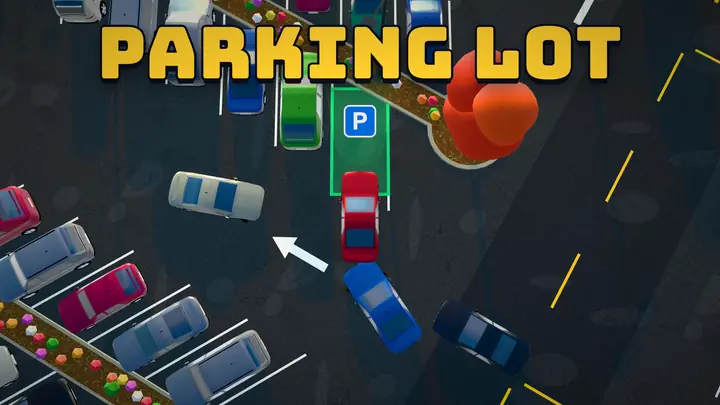
Parking Lot cover art: four cars close in on one free bay, seen from above
Portal buildthree.jsCrazyGames SDK v3

Parking Lot: a portal-ready build

A careful-driving race against three bots, rebuilt as one static folder for CrazyGames: straight into the race, ads only between rounds, and graphics that scale down on weak devices.

364tests passing (8 test files)
1.08 MBwhole build, 9 files
347 KBover the wire, gzipped
2.5 sto the race screen, emulated fast 4G
6.6 son slow 4G with a 4× slower CPU
2 daysfirst commit to portal build, per git

What was built

  • A small platform interface with a CrazyGames SDK v3 adapter (loading, gameplay events, midgame and rewarded ads, mute, device type, saved data) and a no-op fallback when the SDK is missing or takes over 4 s. A Poki or Yandex adapter is one more file.
  • Ad pacing: a midgame ad only after at least 2 rounds and 120 s of play, at most every 180 s. The rewarded hint is offered only after a lost round, next to an equal "No thanks" button.
  • Low, medium and high quality tiers picked from the device, with an automatic step-down after 4 s under 40 fps.
  • A build check that fails on absolute paths, more than 1,500 files, more than 20 MB, or any outbound URL other than the portal SDK.
  • Cover art rendered from the game at 1920×1080, 800×1200 and 800×800.

Timeline from git

  1. First commit: four cars, one free bay, first to park wins
  2. A four-deck car park and six stages, with bots tested in every stage
  3. Portal adapter, ad scheduler and performance tiers
  4. Portal build, build checks and covers

Sources: npm run test:run and npm run build:portal on the portal-build branch, run on 20 Nov 2026; load times from the repo's scripts/portal-load.mjs (headless Chromium, local server, cache off, three runs each: 2.48 to 2.50 s and 6.57 to 6.64 s); design details from docs/TECHNICAL.md section 14.
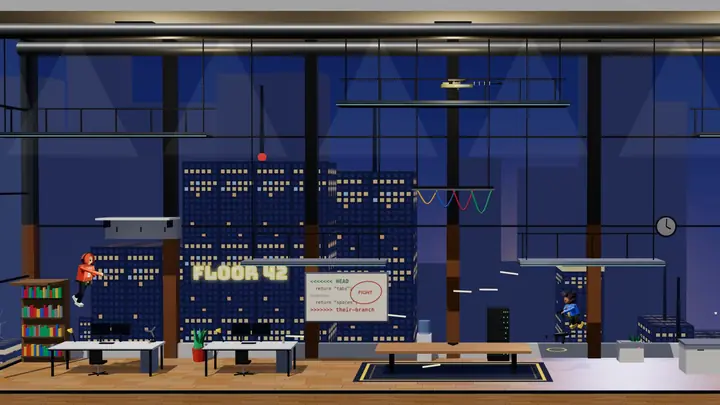
Floor 42: a fighter jumps across a night-time office while the other takes cover
Online netcodethree.jsColyseus on Fly.io

Floor 42: an online duel that stays fair

A side-on 1v1 shootout where the server, or the host's browser, runs the same simulation as the client and decides every hit. The bot and the online mode share one rules engine.

60 Hzfixed-step simulation, same on server and client
30/ssnapshots from the authority
150 mscap on lag-compensation rewind
59tests passing
2 h 41 minfirst commit to online 1v1, per git
3bot difficulty levels

What was built

  • A deterministic simulation: fixed 1/60 s steps, a seeded random generator stored in the game state, and drawing interpolated between ticks so motion stays smooth at any refresh rate.
  • An online mode with client prediction, numbered snapshots and a buffered timeline for the rival, plus a direct peer connection with relay fallback.
  • A lag fix tested on an injected bad network (80 to 180 ms latency, 20 to 60 ms jitter, 1 to 5% loss): the median gap between where a player was hit and where they saw themselves fell from 0.8–1.4 units to 0.1–0.3 on direct connections.
  • Touch controls, landscape layout and full screen on phones.

Timeline from git

  1. First commit: playable prototype with a bot opponent
  2. Online 1v1 on a Colyseus server on Fly.io, with client prediction
  3. Playable on phones: touch controls, landscape, full screen
  4. Netcode rework for players in different countries

Sources: docs/TECHNICAL.md (timestep, snapshots, server loop), the commit "Online play stays smooth and fair across countries" (network test and results), and npx vitest run on 20 Nov 2026.

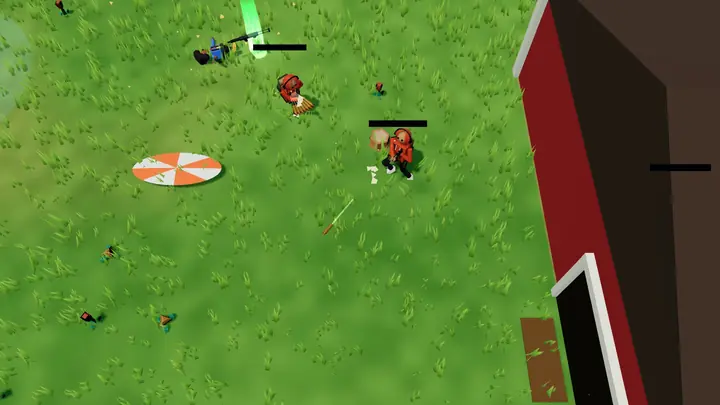
Last Commit Standing: fighters trade fire on a grass field beside a red barn
Battle royalethree.jsBots + online rooms

Last Commit Standing: ten players in a browser tab

A top-down battle royale with a parachute drop, loot, a river to swim and a closing zone. You play solo against nine bots, or share a link and fill a room with friends while bots take the empty places.

10players per round
9bots in a solo round
32tests passing
5 h 22 minfirst commit to phone controls, per git
7 h 19 minfirst commit to online rooms, per git
6weapon types

What was built

  • A simulation that runs the whole round (drop, loot, zone, bots) separately from the renderer, so the same rules drive solo and online play.
  • Online rooms of up to ten where the host's browser runs the round and a small lobby server on Fly.io connects players.
  • Characters animated with two-bone IK for arms and legs, and a generated countryside with grass, trees and wind.
  • A virtual stick and thumb buttons, with a camera and HUD that fit a phone.

Timeline from git

  1. First commit: design doc and battle royale simulation
  2. Playable prototype: drop, loot, zone, minimap, results against 9 bots
  3. Playable on phones
  4. Online rooms of up to ten, bots optional

Sources: git history, README.md, docs/TECHNICAL.md sections 4 and 5, and npx vitest run on 20 Nov 2026.

Your project, measured the same way

Client work comes with the same report: tests, build size and load time, so you know what you are getting.